On claiming disability, and why workplaces make access hard by design
For years, when asked why I was self-employed, I would tell people it's because, "I'm a bad employee."

I said it with a wink and a laugh. It was a joke. It was also a confession. And I believed it. I was constantly in friction with my workplaces for many reasons.
I was annoying and couldn't sit still in meetings. I was lazy and had trouble getting out of bed on achy mornings. I was the troublemaker and pointed out problems and expected them to be fixed. I was rude and spoke plainly to higher ups as if they were peers.
Annoying. Lazy. Troublemaker. Rude. Those were the labels. Underneath them: a nervous system that needed my body to move. Joints that needed a slower morning. A brain wired to spot problems, and a conscience that wouldn't let them slide.
I wasn't a bad employee. I was a neurodivergent and disabled employee in workplaces built to punish that.
Coming home to the word
It took me years to claim disability. Three things got me there.
My body turned up the volume. Symptoms I'd been managing (or masking, or white-knuckling through) increased until they couldn't be ignored anymore.
Disabled community found me. Especially queer and trans disabled folks, who modeled a way of being disabled that was proud, political, caring, and unapologetic as hell.
And I did my own work. I dug into the internalized ableism that kept me afraid of the word. Afraid that naming it would make it true. Or make me less.
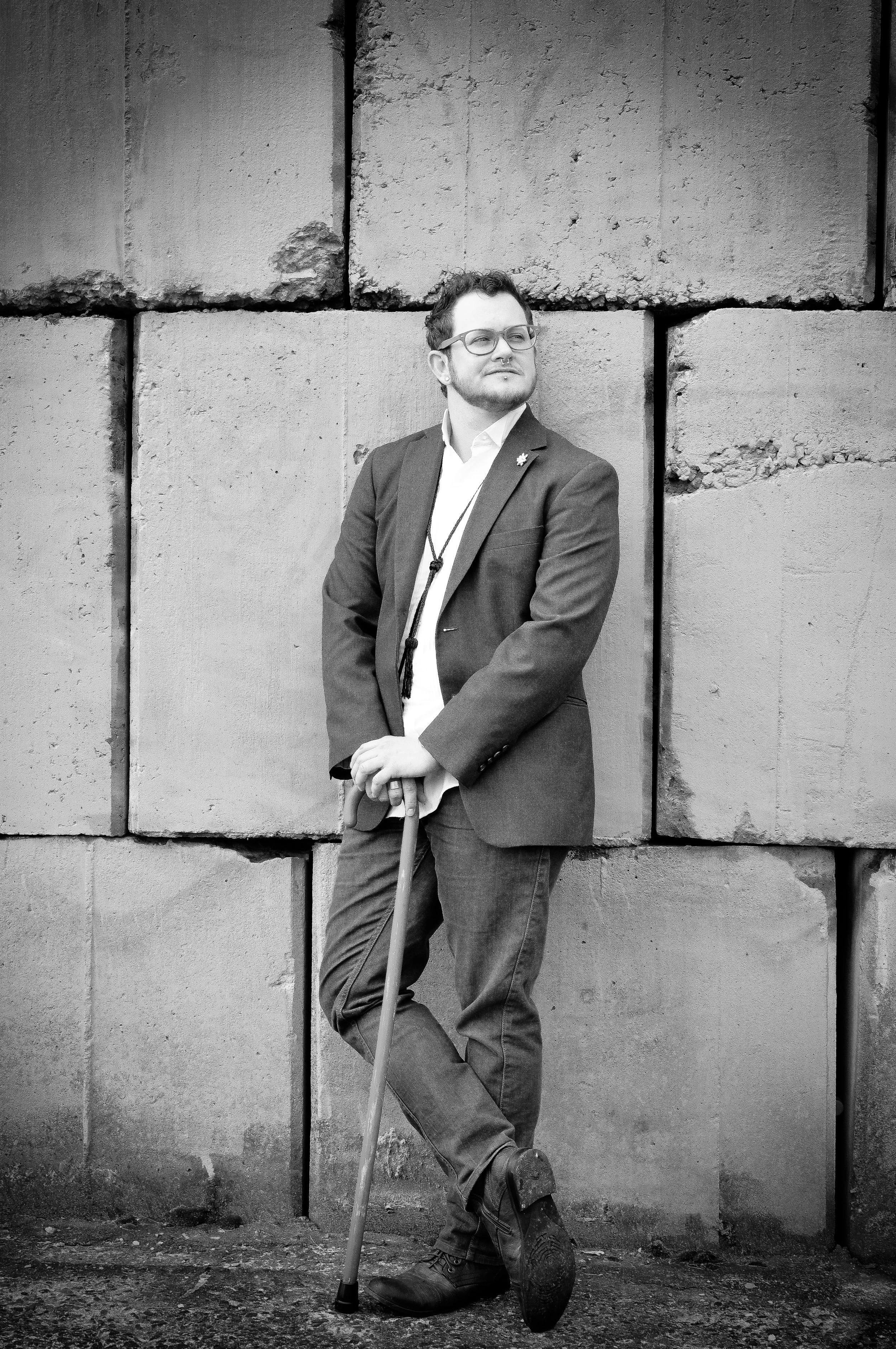
A black-and-white photo of me just after I quit my job and started working for myself over 14 years ago. I am a light-skinned white and Native trans queer person, with brown curly short hair, glasses, a beard, and facial piercings, wearing a suit jacket and a long beaded necklace. I am holding a cane, leaning against a concrete wall, and staring off into the distance.
Now I claim it proudly. I'm disabled.
I'm AuDHD and I live with a collection of chronic conditions that shape how I move, work, rest, and live.
I'm disabled. I say it because it frames a lifelong experience. I say it because I need to own it for myself. I say it because saying it makes room for others to say it, claim it, and live radical disabled lives.
The accommodation that was "impossible"
At the most stressful job I've ever had, my immune system tanked and some days the commute from Brooklyn to lower Manhattan wasn't physically possible. At the time, I had a wonderful boss who said on flare days, I could work from home. It wasn't often, and it worked.
Then that boss moved to another department. My new supervisor honored the arrangement at first, until she learned it had never been officially approved by the organization. So she paused the accommodation, sent it up the chain, and it was denied.
The reason? It was impossible to do my job from home. The job I had already been doing from home, on and off, for years, the job I'd also done from hotel rooms and other cities while traveling, suddenly impossible.
The disability loop
Here's what happened next.
I fought it. Fighting for the accommodation added stress. Stress made my flares worse. Worse flares made the job harder to do without the accommodation I'd just been denied. Which added more stress.
That's the loop. The system creates the barrier. The barrier creates the harm. Then the harm gets read as a performance problem, as proof the person is "bad."
I'd absorbed that message for years before I had language for it. Once I had the language, it got simple:
I wasn't bad at being an employee. Employers are bad at supporting disabled staff.
Disabled people work. Just not the way you were trained to expect.
October is National Disability Employment Awareness Month, so let's name the thing.
Disabled people are pushed out of the workforce on a massive scale. The assumption baked into that: disabled means unable to work. The truth: disabled means we do our work differently. Our contributions just don't get valued the way non-disabled contributions do. But that's a valuation problem, not a contribution problem.
The real truth is, disabled people are workplace assets. Because, for real, disabled experience brings real transferable skills.
In a world that was not built for us, every day is a masterclass in design, logistics, negotiation, and communication. How do I get into this building? How do I make sense of this report? How do I communicate across this gap? We are met with challenges at every turn and we show up anyway. Just showing up is proof that we've already solved a long list of problems with innovation, ingenuity, tenacity, creativity, and plain ol' gumption.
To be disabled is to translate the world, often by inventing what doesn't exist yet. To get access, we name what we need, ask, and build networks of interdependence. Those aren't workarounds. They're the skills most organizations want and can't figure out how to build.
Make access a celebrated part of your culture, and you open up entirely new ways of working. Not charity. Transformation.
Inaccessible by design
Organizations make accessibility intentionally hard. Not by accident, and not because of one bad manager. The difficulty is the design, and it runs on a few predictable moves.
Distrust is the default. Most accommodation processes start from one assumption: disabled people asking for access are trying to game the system. Grifters until proven otherwise. So the burden falls on us to prove our pain, again and again, to people who've already decided not to believe it.
Distrust teaches us to doubt ourselves. When a culture treats access needs as suspect, everyone learns to suspect their own. Do I actually need this? Is it really that bad? Am I just being difficult? That doubt impacts everyone — anyone with a body or brain that doesn't fit the mold — whether or not you identify as disabled. So many of us stop asking and muddle through in silence.
And without what we need, we struggle, and then that struggle gets used as proof we couldn't do the job. That's not a flaw in the system. It's what the system was designed to do.
Policy beats proof. Institutions will choose their rules over their people, even when the evidence is sitting right there. My job was "impossible" to do remotely, despite years of doing it. "Impossible" was a policy, not a fact. It wasn't protecting the work. It was protecting the hierarchy.
Managers enforce down instead of advocating up. Managers are supposed to have our backs. Too often, they side with the institution instead. My supervisor, the person best positioned to fight for me, sent my request up the chain and let it die there. Same job, same body, same need. The only difference was whether someone chose the person or the process.
Denial doesn't erase the need. It moves the cost. Disabled workers pay it in pain, stress, and worsening health. Organizations pay it in people who can't do their best work, talent that goes untapped, and good people who eventually walk out the door. I paid it in flares. Nobody won.
Individual needs are community needs. When one person can't be fully present, the team doesn't have all of them. Access is a shared responsibility, because everyone pays when someone goes without.
How to do better
Start from trust. Disabled people are the experts on our own bodies and minds. Believe us.
Make Yes the default. If the work is getting done, that's your answer. Save the scrutiny for the policy, not the person.
Managers, go to bat for your people. Your job is to advocate up the chain, not to enforce down it.
Treat access as ongoing. Needs shift. Check in, and revisit without making people start from zero.
Make it everyone's business. Access isn't one person's special request. It's how the whole team gets to show up.
So, about that "bad employee"
I wasn't bad. I was the canary in the coal mine, and I was bouncing my chair.
The things that got me labeled annoying, lazy, a troublemaker, and rude are exactly what disabled and neurodivergent people bring when workplaces stop treating access as a burden and start treating it as a practice.
Liberation is in the direction of joy. Disabled joy is very much included.
Yours In Praxis,
Leigh
The 2-Minute Access Check
Try this at your next meeting. Open with a two-minute access check-in.
Ask “What do you need for yourself and each other for you to fully participate and engage today?”
Name. Each person names what they need to be fully present today.
Listen. to and make note of what is said.
Negotiate if there are needs that seem to be in conflict.
Agree out loud.
Then check back in next time, because the answers will shift.
Awkward the first time? Maybe. Transformative by the fifth? I'd bet on it.
This month, don't stop at awareness. Ask your people what they need, and mean it. Build the practice. Make access everybody's job.

Ready to Do it Differently?
I work with organizations and leaders to build inclusive, accessible, and equitable practices, policies, and cultures. Through coaching, consulting, strategy, and thought partnership, we can explore all the good work you’re doing, and where you can grow. Let's get started.