The Mistakes Even Good Facilitators Make
IN PRAXIS: Notes on Reflection and Action: I write occasional newsletters sharing notes, tips and tools from the field—my place for reflection and action after two decades of building liberatory practices and sustainable movements. Sign up below.
I have been facilitating my entire life. It is a craft I love—genuinely, deeply, obsessively love. And I love to figure out how things function. I am the type person who keeps a notebook on their lap at every play, every workshop, every presentation I've ever attended. I study what works. I study what doesn't. I pull things apart and look at the pieces.
So when I say I've seen some patterns? I've seen some patterns.
Here's the truth nobody likes to say out loud: facilitation is a skill. An actual, learnable, practiceable, refineable skill. But most people end up in the role not because they trained for it — but because they happened to know a thing. They had expertise, a body of knowledge, a job title. And suddenly they were in front of a room. Nobody told them there was a how.
If you're reading this, you already know what I'm talking about. You've sat through the droning lecture. The slide deck where every spoken word is also on the screen. The workshop packed with activities that went absolutely nowhere. You felt it in your body.
This is for everyone who's ever wanted to do it differently. Here's what's getting in the way — and what to do instead.
4 Mistakes I See (Over and Over)
Overloaded agendas treated like contracts. Too many activities, every transition planned, no room to breathe. When something unexpected and important happens in the room, there's nowhere to put it.
Closed questions instead of open ones. A closed question has one right answer. What is the capital of Uruguay? Either you know it or you don't — and if you're not sure, you're keeping your hand down. An open question invites experience, reflection, interpretation. What does home mean to you? There's no wrong answer. Everyone has one.
Instructions that leave nothing to the imagination. Long, over-detailed instructions don't just eat time — they script exactly how participants are supposed to show up. Which means there's no room for creativity, interpretation, or anything unexpected. Which means the most interesting stuff never gets to happen.
Didactic, prescribed lessons. Telling participants what they're supposed to learn, describing what and how the participants should grow from an activity. Delivering prepared, prepackaged takeaways without inquiry.
All of these mistakes share a root.
Facilitators don't trust their participants.
They don't trust participants to bring their own inquiry and reflection to the work. They don't trust them to engage with an activity and make something real from it. They don't trust that the lived experience and expertise already in that room is the most powerful learning tool available.
And so they fill the space. Over-explain. Over-plan. Over-instruct. They deliver the experience instead of guiding participants through the process to explore, discover, and grow.
Here's what that produces: participants who perform learning. Who give back what they think the facilitator wants. Who can recite the learning objectives at the end of the workshop—and forget them by Tuesday.
Real growth doesn't work like that.
It's when someone takes a framework, connects it to their own life, and actually uses it somewhere outside the room. That doesn't happen when every moment is managed. It happens when there's enough trust—and enough space—for participants to bring themselves to the work.
It can be hard to practice, but there are some key tips that can help turn didactic, stranglehold workshops into transformative experiences.

In Practice
Here are some facilitator tips to lean into participant experience and engagement and support real transformation.
1. Reduce the number of activities—and protect the space around them
More activities ≠ more learning. Often it means less. When a workshop is packed wall to wall, there's no room for participants to process what just happened — which is where the actual growth lives.
Choose a few good activities. Not all of them. A few.
Build in time before and after each one — to set up, and to reflect.
Keep a grab bag list on your agenda: backup activities you can pull if the conversation shifts, time runs short, or there's more space than expected.
The agenda is a guidepost, not a contract. Write it so you have something to throw away.
2. Talk Less
This one is harder than it sounds — and more important than most facilitators realize.
The more a facilitator talks during instructions, the less room participants have to bring their own interpretation and analysis to the work. Over-instruction doesn't just eat time. At its worst, it teaches participants to replicate what they think you want, rather than what they actually think.
Play this game: How few words can I say this in and still get my point across?
For written instructions: read through them and cut.
For spoken instructions: record yourself and listen back.
Ask: what is actually necessary here? What can participants figure out on their own?
Leave open space. That's where they bring themselves — and that's where the learning lives.
3. Ask for Reflection. As Often as Possible.
Before you say a single word about what an activity meant — ask.
Questions to keep in your back pocket:
What was your experience?
What skills or tools did you use to complete this?
What surprised you?
Where did you notice similarities or differences between how you engaged and how others did?
What did you learn?
Did you like it? Did you not? Why?
Then listen. Really listen.
If participants name the things you were going to say — write them on the board and leave them alone. They're already theirs. If something's missing, offer it as a question, not a conclusion: This reminds me of... Does that resonate? Did anyone else experience something like that?
Resist the urge to tell participants what the lesson is. Let them tell you.
Your job is to build the conditions — and then trust people enough to get out of the way.

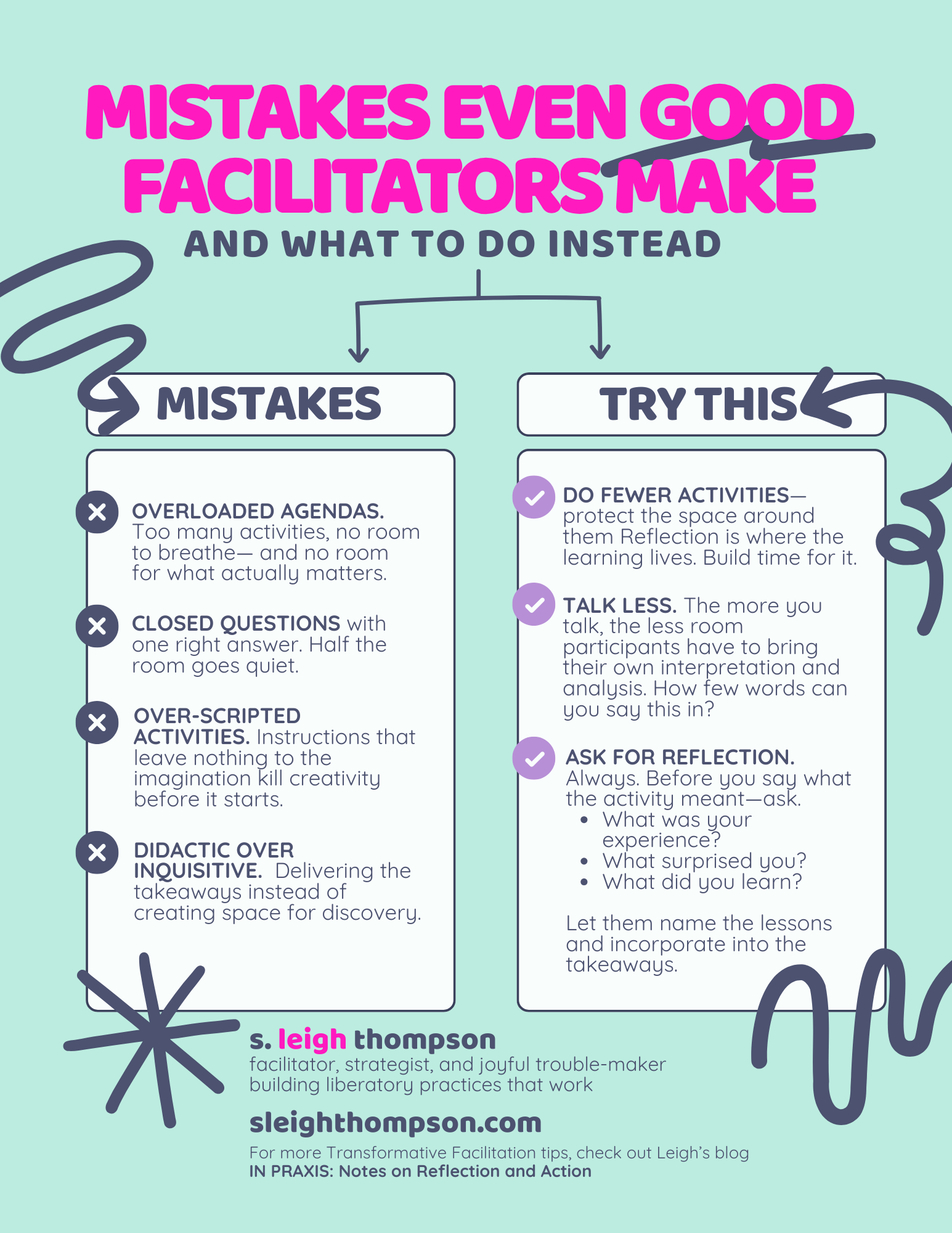
Click to download this as a sharable resource

Ready to Do it Differently?
I design and lead workshops, dialogues, and facilitated experiences for folks ready for something deeper. If you need to build real facilitation capacity on your team, create a learning experience that actually changes how people think, or just need someone who can hold a hard room without flinching—that's the work. Let's get started.